- Home
- FAQs. Facts About Cats
- How Do Cats Purr?
How Do Cats Purr?
"How do cats purr?" a friend's little boy asked recently, playing with Bandit. This followed hard on the heels of "why do cats purr?" Some kids are never satisfied! But it's a fair question, and one that's always fascinated me, too.
I didn't really know, though, and he wasn't happy with that, so I promised to find out. The answer is, perhaps surprisingly, that no-one really knows how cats purr.
Cats are one of the few species able to produce a purring sound, but there's no specific 'cat purr mechanism' – no part of a cat's body that isn't found in other animals too.
So scientists don't really know which bit of a cat is responsible for producing a purr, though they have several theories.
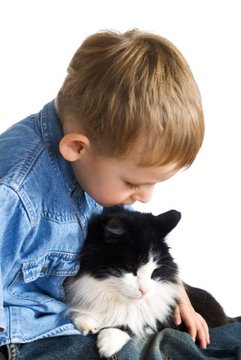 How do cats purr?
Image © iStockphoto : Larisa Lofitskaya
How Do Cats Purr When Their Mouths Are Closed?
We do know that cats purr without opening their mouths, and that they can purr continuously, both when breathing out and breathing in.
This suggests that the rumbling we hear as a purr is generated by air flowing over something that vibrates. But what is it?
The Larynx?
One theory is that purring is caused by nerve signals from the brain to the muscles in the larynx, or voice box, where the vocal cords are found.
The nerve signals cause the muscles of the larynx to tense and relax in quick succession, which in turn causes the vocal cords to vibrate. The sound of purring happens as air flows over the vibrating vocal cords as it's drawn in and out of the lungs by the diaphragm.
Scientists know that a cat with a paralysed larynx can't purr, so this theory may be at least partly correct.
False Vocal Cords?
Another popular theory is that the vibrations of purring are generated by air flowing over 'false vocal cords' (also known as vestibular folds), a pair of membrane folds located in the larynx behind the real vocal cords.
These folds seem to have no other specific function, so perhaps they are the undiscovered 'cat purring mechanism' - there just for the purpose of purring?
The Hyoid?
The anatomy of a cat's head includes a series of small bones called the hyoid apparatus, found between the skull and the larynx.
The actual purpose of the hyoid apparatus is to support the tongue, but this third theory suggests that vibrations of the bones of the hyoid may be the source of the purr.
Or the Chest?
In earlier veterinary days it was believed that purring was generated by blood rushing through the inferior vena cava, one of the blood vessels bringing de-oxygenated blood back to the heart.
In this theory, the muscles of the diaphragm expanding and contracting around the vein set up a rhythmic vibration and the noise of this was then magnified by air in the lungs.
This theory has now been discounted, though.
So How Do Cats Purr?
Listening to the sound of cats purring must be one of the most relaxing things a cat owner can do. But it seems we still don't quite know how they do it.
I've spent hours both listening to and watching my cat purring. If you look closely, and feel a cat's body as it purrs, the vibration definitely seems to be strongest in the throat.
But when you stroke a purring cat, you can feel the vibration all down through the body, too, so perhaps we don't have the full story yet.
One thing's for sure though. Cats know. But they're not telling ...
More Cat Questions
Some of the articles and newsletters on this site may contain links to products I think you may enjoy. If
you purchase through these links I receive a small commission, but there's
no extra cost to you. Find out more on the Affiliates Disclosure page.
Have You Discovered Our Newsletter?
If not, why not? Subscribe to our email newsletter, Meezer Musings, to stay in touch, be the first to see new information and pages as they come out, and read the things we only talk about in the newsletter.
Learn more about it on our Newsletter Sign-Up page.
First Visit Here?
Below you'll find links to some of our popular articles, topical pages, newsletters and other items of interest.
Click the images or links below them to visit those pages.
FTC
Disclosure: If you make a purchase via a link on this site, I may
receive a small commission, at no extra cost to you. See our Affiliates Disclosure for further details.
Most Popular Pages


Meezer Musings -
Latest Newsletters



Find Us on Facebook
Information provided on this website is not intended to replace professional advice.
If you have any concerns at all about your cat's health, please consult a vet.
Life with Siamese
Cats does not sell any personal information from this website.
To find out more please see our Privacy Policy.
Copyright © 2009-2024 Caroline Haines, Life with Siamese Cats. All Rights Reserved.