- Home
- Related Breeds
- Ragdoll
The Ragdoll Cat Breed. Ragdoll Cats Are Floppy Cats!
Here we take a look at the Ragdoll cat breed, investigating its history, health and looks. There's information, too, about the three different kinds of Ragdoll cats (Mitted, Bicolor and Colorpoint) that make up
the breed, which are all shown below in the Ragdoll
cat pictures on this page.
Ragdoll Cat History
The Ragdoll cat breed name comes from the way cats of this breed have of collapsing in their owner's arms when they're picked up. All floppy, just like a rag doll!
First heard of in 1965, there's a lot of mythology surrounding Ragdoll cats, as well as a certain amount of controversy. So just where did all this intrigue come from?
It's said that the 'mother of the breed' was a long-haired white cat called Josephine, who was injured in a car accident and received a fractured pelvis.
Josephine (probably as a result of an
accidental mating, which according to some sources may have been with a
Burmese, Birman, or both) subsequently gave birth to a litter of three
kittens, all possessing this 'floppy' characteristic.
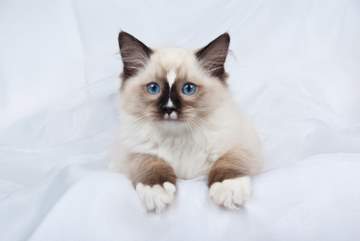 Mitted Ragdoll. White mittens and chin, thin white stripe on nose
Image © iStockphoto | Linn Currie
The rest, as they say, is history – or perhaps mythology. It's claimed that the kittens' 'floppiness' is a result of their mother's injury, but this would be genetically unlikely.
It's more probable that this, as well as some of the Ragdoll breed's other characteristics (their placid and docile nature and lack of survival instinct) were received through selective breeding from cats who already possessed these traits.
One
of Josephine's kittens was mated to a Birman-like cat (with the splendid name of
Daddy Warbucks!) who became the Ragdoll founding father.
Ragdoll Cat Health and Care
Modern Ragdolls look quite similar to Birmans, or perhaps Himalayans. They're large, stocky, healthy cats, with the males typically weighing between 15-20lb, females slightly less.
They have thick coats which are easy to care for as their fur does not mat. As with all long-haired cats, regular brushing and combing is necessary to keep the coats in good condition.
Because of their non-aggressive and placid nature,
Ragdoll cats should be kept indoors or in a safe enclosure; they're not
good at defending themselves.
Ragdoll Varieties and Colors
All Ragdolls have large blue eyes, medium-size rounded ears, a long bushy tail, and large round paws, which have tufts of fur between the toes.
There are three variations of the Ragdoll cat breed. All are
found in the seal, chocolate, blue and lilac point colors. The kittens
are born completely white and it can take up to three years before their
true colors are known.
The Mitted Ragdoll
Many Ragdoll cat breeders consider that the Mitted Ragdoll (seen in the photo above) is the only true version of the breed.
These cats have white chins, bibs and chests with a stripe running all the way from the bib along the stomach to the tail. Mitted Ragdolls are also allowed a narrow stripe on the nose.
Their name comes from the white 'mittens' that should be seen on the front paws; the back legs have longer 'boots'.
The Bicolor Ragdoll
The Bicolor
Ragdoll is similar to the Mitted, except that the legs, chest
and stomach are all white. There should be no white markings on the ears
or tail. It does, however, have a white inverted 'V' extending down
between the eyes over the nose, muzzle and chin.
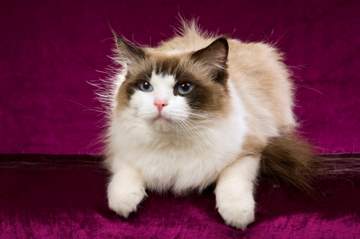 The Bicolor. Long white gloves and chest, ruff and inverted 'V' over nose
Image © iStockphoto | Linn Currie
The Colorpoint Ragdoll
The Colorpoint Ragdoll, as its name suggests, has a pale body with points (ears, face, paws and tail) in one of the four main point colors.
The Colorpoint does not have the white facial markings of the other varieties and in fact there should be no white markings at all on the points.
The Colorpoint looks very like a cross between a Siamese and a Persian, which is
perhaps why the Ragdoll cat breed is sometimes mistaken for a
long-haired Siamese.
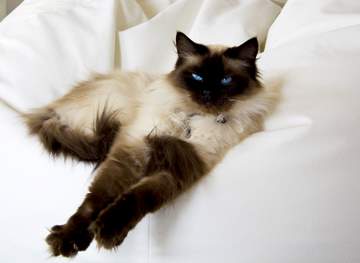 Seal Colorpoint. No white on points. Note the tufted paws!
Image © iStockphoto | Daniel Käfer
Further Reading
For further information about Ragdolls and how to look after them, the following books, available from Amazon, are popular and well-rated books about the breed.
- Ragdoll Kitten Care Guide: Bringing Your Ragdoll Kitten Home (Jenny Dean)
- Guide to Owning a Ragdoll Cat (Gary Strobel & Susan Nelson)
- The Friendly Floppy Ragdoll Cat (Kimberly H Maxwell)
Other Siamese Relatives
Some of the articles and newsletters on this site may contain links to products I think you may enjoy. If
you purchase through these links I receive a small commission, but there's
no extra cost to you. Find out more on the Affiliates Disclosure page.
Have You Discovered Our Newsletter?
If not, why not? Subscribe to our email newsletter, Meezer Musings, to stay in touch, be the first to see new information and pages as they come out, and read the things we only talk about in the newsletter.
Learn more about it on our Newsletter Sign-Up page.
First Visit Here?
Below you'll find links to some of our popular articles, topical pages, newsletters and other items of interest.
Click the images or links below them to visit those pages.
FTC
Disclosure: If you make a purchase via a link on this site, I may
receive a small commission, at no extra cost to you. See our Affiliates Disclosure for further details.
Most Popular Pages

Meezer Musings -
Latest Newsletters

Find Us on Facebook
Information provided on this website is not intended to replace professional advice.
If you have any concerns at all about your cat's health, please consult a vet.
Life with Siamese
Cats does not sell any personal information from this website.
To find out more please see our Privacy Policy.
Copyright © 2009-2024 Caroline Haines, Life with Siamese Cats. All Rights Reserved.