Bathing a Cat: Do's and Dont's
Bathing a cat is not really a good idea because on the whole, cats don't much like water (unless they're Bengals, who positively enjoy splashing around in puddles).
Cats have all they need to keep themselves clean, so giving a cat a bath is generally only necessary in extreme circumstances.
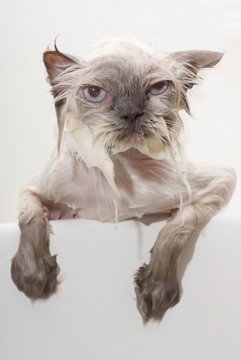 I can't believe you just did that!
Image © iStockphoto | Debbi Smirnoff
For example, if they get covered in an oily or toxic substance that they can't remove by themselves, or when they come into contact with something evil-smelling, or get invaded by ticks or fleas.
Occasional bathing will also probably be needed for long-haired cats and essential for the Sphynx breed, whose lack of fur means that the oil produced by their bodies is not removed in the normal way. (Normally, excess oil is removed from a cat as their fur is either groomed out or falls out.)
You need nerves of steel when bathing a cat. But if you do need to give your cat a bath, here are our instructions.
Before Bathing a Cat. Prepare:
Yourself
Wear old clothes - jeans and a long-sleeved shirt or sweater to protect your skin from getting scratched.
Your Cat
Clip your cat's nails. Many an unsuspecting owner has been badly scratched by unhappy cats trying to flee the scene! Once you've done that, keep your cat secure and safely out of the way while you organize ...
The Kitchen or Bathroom
The kitchen is a good place for bathing a cat, especially if you have a double sink. One half can then be used for soaping and the other half for rinsing off.
Whether you have a single sink or a double one, if you use the kitchen sink it's a good idea to take a folded towel and lay it on the counter at the edge of the sink, with the open end of the folded towel level with the edge, so that when you've finished, your cat can climb up straight up into the towel.
Another idea is to put a large towel at the bottom of the sink to give your cat something to grip onto.
(The tips above about the towels were sent to us by one of readers, Diane. Thank you Diane!)
Alternatively, you can use the bathroom shower or bath, where you have the added advantage of a shower head for to rinse with. If you decide on the bathroom, one way is to use the bucket method - use two buckets (or large saucepans or similar containers) one for the soapy water, one to rinse.
Whichever room you choose, make sure that all breakable items are moved well out of harm's way.
Your Tools
Collect together everything you'll need. Sponge or face cloth, specially formulated shampoo for cats, or flea shampoo if you're treating fleas.
Don't use human shampoo or soap as these can harm the animal's skin and fur. You'll also need a brush, a comb and several large towels.
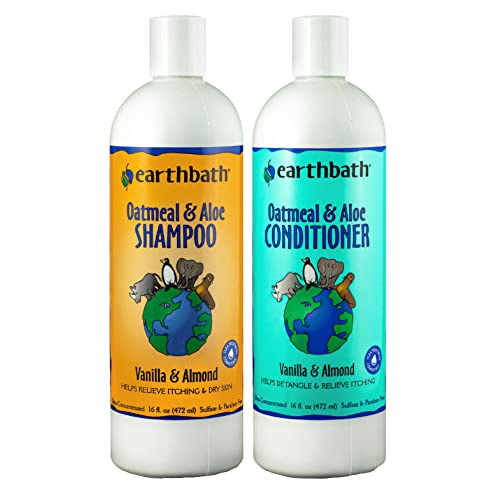
The shampoos below, available on Amazon, appear to be well-tolerated by most cats.